The mental load of a new baby: why one parent holds it all
The mental load is a real, studied thing, and a newborn makes it heavier than anything else. What the research says about it, and what actually shifts it.
Martynas · 27 July 2026
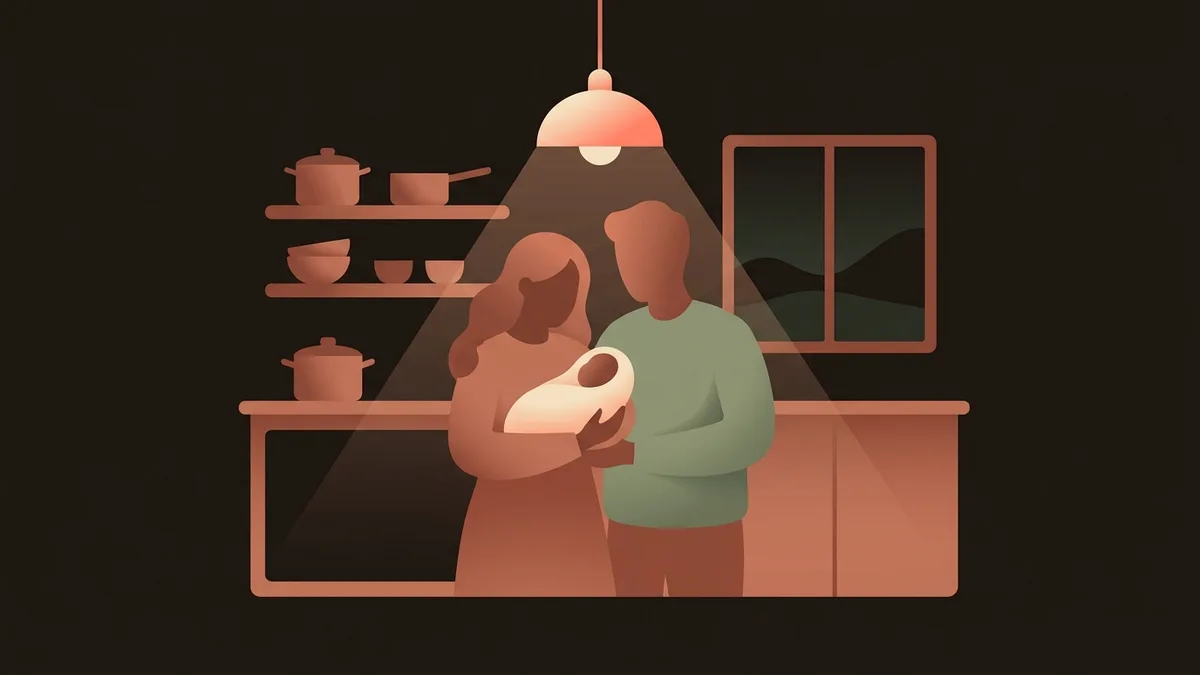
One of you knows when he last fed, how the night went, whether the drops were given, when the health visitor is coming, that the 0–3 sleepsuits stopped fitting last week, and that he has been oddly quiet since lunch.
The other one is helping. Genuinely, constantly helping. And is asking, several times a day, what needs doing.
That gap is not about effort, and it is not about who loves the baby more. It has a name, it has been studied, and it is the part of new parenthood that is hardest to hand over.
What the mental load actually is
The sociologist Allison Daminger interviewed 70 people across 35 couples and argued that the non-physical part of running a household is its own kind of work — cognitive labour. Her paper breaks it into four parts: anticipating a need, identifying the options for meeting it, deciding, and monitoring whether it actually got done.
Two of those four are the invisible ones. Deciding is visible — it happens out loud, usually together. Doing is visible. Anticipating and monitoring happen silently, in someone's head, all day.
Daminger found that women in her study did more cognitive labour overall, and specifically more of the anticipating and the monitoring — while participation in decision-making was roughly equal. That is worth reading twice, because it explains why a couple can feel like they are sharing everything and still have one person quietly running the whole operation. The decisions were shared. The noticing that a decision was needed was not.
Why a newborn makes it so much heavier
A baby turns that background job into a full-time one, for three reasons.
Everything is time-sensitive and nothing is written down. When he last fed determines when he next feeds, which determines when he can nap, which determines whether you can leave the house. Miss one link and the chain has to be rebuilt from memory.
The information changes every few days. The wake windows that worked last week are wrong this week. There is no stable state to memorise. Wake windows lengthen in jumps, not smoothly.
The person holding it is the least-rested person in the house. A longitudinal study following 232 couples from pregnancy through the first year found that mothers had significantly poorer sleep quality than fathers at every point in the first 12 months — more night wakings, worse sleep efficiency, higher insomnia scores — and that maternal sleep tracked infant sleep far more closely than paternal sleep did. The authors attribute part of that to mothers remaining primarily responsible for night-time infant care.
So the person doing most of the anticipating and monitoring is also the person being woken to do it. That is not a division of labour anyone chose. It is what happens by default.
🦘 Buma gives both parents the same live record — not a report one of you sends the other. Get Buma →
The handover problem
Here is where it usually surfaces. One parent takes the baby for a few hours so the other can sleep, and within twenty minutes there is a text: when did he last eat?
The question is reasonable. The problem is that answering it costs the sleeping parent the sleep. The load did not move; it got a longer commute.
Any real handover needs three things the helping parent can find without asking: when he last fed, when he last woke, and anything unusual today. Those three cover most of what an afternoon requires. A parent who can look them up is genuinely covering. A parent who has to ask is being supervised.
The same applies to a grandparent, a nanny, or nursery. The information is not secret. It is just stored in a place only one person can read.

What actually shifts it
Very little of this responds to trying harder. What moves it is changing where the information lives and who owns a category.
Write it down as it happens, not afterwards. The moment it is in a shared place, anticipating stops being a memory task. This is the single biggest change, and it is mostly mechanical.
Hand over whole categories, not tasks. "Can you do a nappy" leaves the anticipating and the monitoring exactly where they were. "You own nappies and the supplies for them" moves all four parts. Categories that transfer cleanly: bath and bedtime, nappy stock, appointments and the diary, laundry, the nursery bag.
Let the other parent be wrong sometimes. Monitoring is the hardest part to give up, because handing it over means accepting that something will occasionally be done differently or not at all. A partner who is corrected every time learns to ask rather than to decide, and asking puts the load straight back.
Have one record, not two. Two people keeping separate notes is worse than one keeping notes, because now someone has to reconcile them. One shared history that both can write into is the version that works — and it should show who logged what, so a question has an answer instead of an argument.
Say the invisible part out loud. "I am the one keeping track of when he outgrows things" is a sentence most partners have never heard, and cannot act on until they do. Daminger's finding was that this work is often invisible to the person doing it as well.
If you are the other parent
If you have read this far and recognised yourself as the one who asks rather than the one who knows, none of it is a character verdict. It is a default that takes deliberate effort to escape.
The most useful thing you can do is stop asking and start looking — take a category outright, and take the night-time part of it seriously. The same longitudinal study found that fathers slept fewer hours overall but with better quality, which means the capacity is usually there even when it does not feel like it.
And the load does not become fair by one person doing more chores. It becomes fair when both of you can answer the question.
When to ask someone
Exhaustion and low mood after a baby are not the same thing, and the second one needs help rather than a better system.
Talk to your GP or health visitor if, for more than a couple of weeks, you have a persistent low mood, no enjoyment in things you used to like, trouble concentrating or making decisions, difficulty bonding with your baby, or you are withdrawing from people. That applies to both parents: the NHS notes that up to 1 in 10 new fathers become depressed after having a baby, and that it is more likely when the mother is depressed too.
Get help even if you only have some of the signs. In England you can also refer yourself to an NHS talking therapies service without going through a GP. If you ever have thoughts of harming yourself or your baby, call 111 or 999 straight away.
Questions parents ask
What is the mental load?
The invisible work of anticipating what is needed, working out the options, deciding, and checking it got done. Daminger's study of 35 couples named these four components and found women did more of the anticipating and monitoring, while decision-making was split roughly evenly.
Why does it fall to one parent?
Mostly by default rather than by agreement. Whoever is on leave, feeding at night, or at the first appointments accumulates the information, and once one person holds it, asking them is faster than looking it up — which concentrates it further.
How do we actually share it?
Move the information out of one person's head into somewhere both of you can read and write, and hand over whole categories rather than individual tasks. Sharing a chore does not share the load; owning a category does.
Does an app fix this?
Not on its own. An app removes the memory problem, which is a real part of it. It does not decide who owns nappy stock, and it does not stop one parent correcting the other. Those are conversations.
We are not a two-parent household. Is any of this relevant?
The anticipating and monitoring still exist, and still cost the same. Getting them out of your head matters more when there is nobody to hand them to — for you, and for anyone who steps in for an afternoon.
The short version
The heavy part of new parenthood is not the nappies. It is being the only person who knows what happens next.
That is fixable, and mostly not by trying harder. Put the day somewhere both of you can see it, hand over categories rather than jobs, and accept that a partner who is allowed to get it slightly wrong is a partner who will eventually get it right without being asked.
Buma is a record-keeping app, not a medical device, and nothing here is medical advice. For anything that worries you, talk to your health visitor, GP or paediatrician.
Put the day somewhere you can both see it
The information does not need to live in one person's head. It only ends up there because nowhere else is convenient at 3am.
Buma is a baby journal for iPhone and Android built for two parents from the start — one invite code, one shared history, every entry stamped with who logged it and who last changed it. Whoever takes the afternoon can look up the last feed instead of texting the person who is finally asleep. Get Buma on the App Store or Google Play.
Sources
- The Cognitive Dimension of Household Labor — American Sociological Review, 2019
- Sleep of mothers, fathers, and infants: a longitudinal study from pregnancy through 12 months — SLEEP, Oxford Academic, 2023
- Postnatal depression — NHS, 2025